



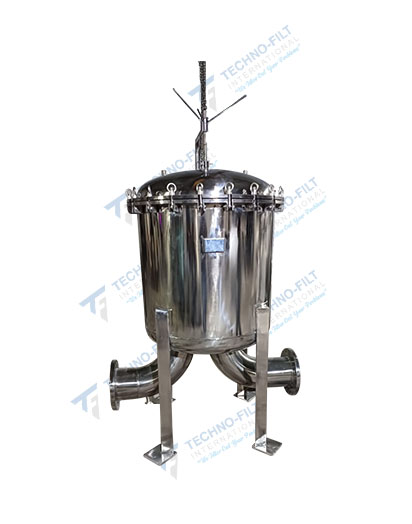
Bag filter housing is one of the most important yet commonly ignored components in any industrial process line. It works silently, 24/7, keeping contaminants out of your product, protecting your equipment and keeping your operations clean and running efficiently. Here’s the uncomfortable truth: It’s rare for a bag filter housing to announce its imminent failure with dramatic warning signs.
Instead, it just fails silently. Contaminants remain undetected. Product quality deteriorates. Downstream equipment starts to foul. Regulatory audits find non-compliant batches. By the time you know something is wrong, the damage is done: compromised product batches, fouled heat exchangers, failed downstream equipment, failed quality audits.
Ignoring these subtle warning signs can be costly: unplanned downtime, product recalls, regulatory fines, customer loss, and costly emergency repairs.
In this blog we cover the 7 most important warning signs that your bag filter housing is silently allowing dirt to pass through, why each one is dangerous, and give practical steps to diagnose and fix each of the problems.
⚠️ Warning Sign #1: Sudden Drop in Differential Pressure
What's going on
During normal operation, contaminants accumulate on the filter bag, causing a slow, predictable rise in differential pressure (the difference in pressure between the inlet and outlet of your filter housing). This is a good sign, it means the filter is working and catching dirt and particles.
But an unexplained, sudden drop in differential pressure with no filter change-out is almost never good. Actually, it’s a red flag. A quick pressure drop usually indicates one of three catastrophic failures:
- A hole in the media of the filter bag itself causes a tear or bypass, allowing unfiltered fluid to pass through.
- The bag has fallen down or moved inside the housing – no longer touching the basket or seal.
- The seal or gasket has failed, allowing fluid to bypass the filter media entirely and go straight through.
Why It’s Dangerous
Fluid that bypasses the filter media through any of these mechanisms allows 100% of contaminants to pass undetected to your downstream process. It contaminates your product. Your heat exchangers clog. Your pumps break down early. Your sensors and instruments start to fail. And you don’t even know it’s happening, because the pressure gauge still shows something has been filtered.
In pharmaceutical or food & beverage applications, this could mean an entire batch of contaminated product entering the market – resulting in recalls, regulatory violations and loss of customers.
How to Repair
- Stop process immediately and release the pressure from the housing.
- Visually inspect the filter bag for physical damage, such as tears, pinholes, seam failure or deformation.
- Inspect the gasket and O-ring for signs of wear, flattening, hardening, or chemical breakdown.
- Be sure the bag is seated properly in the housing basket (no gaps at the collar or top).
- Use better quality filter bags. Have bags made of material of consistent thickness and with consistent seams.
- Install a downstream turbidity monitor or particle counter to detect bypass events in real time, even when the differential pressure readings are normal.
⚠️ Warning Sign #2: Your filtered product is discoloured or contaminated
What's Happening
If you see any unexpected discolouration, cloudiness, visible particles, off-specification turbidity readings or abnormal particle counts in your filtered output it is almost certain that your bag filter housing is allowing contaminants to pass through. This is especially critical in food & beverage, pharmaceutical, chemical and cosmetics industries where product purity is not just important – it’s non-negotiable.
The contamination can be:
- Particles or sediment that can be seen in a clear fluid.
- Cloudiness or haze in an otherwise clear product.
- Colour shift that shouldn’t be.
Your QC lab test results that are off-spec
Why It's Dangerous
Contaminated output can lead to not just product quality issues, but also a domino effect of problems such as regulatory non-compliance, customer complaints, product recalls, loss of customer accounts, damage to reputation and financial losses. Depending on the industry, a single contamination event can cost millions.
How to Fix It
- Immediately stop the process and perform a quality control test.
- Check the filter bag for bypass (tears, pinholes or improper seating).
- Look at the micron rating of the bag you have installed – it may be too coarse for your actual contaminant profile.
- Make sure you have the right type of bag for the fluid you are using (felt, woven, membrane-laminated or speciality media).
- Check the housing basket for corrosion, holes, warping or deformation that would allow the bag to move or bypass.
- “Consider upgrading to Techno-Filt’s multi-bag housings with precision-engineered baskets that hold bags firmly in place, eliminating shifting and bypass.”
- Do a full system audit to determine any other potential sources of contamination.
⚠️ Warning Sign #3: Filter Bag Life Is Abnormally Short
What's Happening
If your filter bags are Clogging and need to be replaced way before their rated service life or your historical average, this is a clear sign that something is fundamentally wrong – either with the bags, the housing design or upstream process conditions.
Common errors include:
- The bag is rated down to 5 microns but your actual contaminant particles are smaller than that.
- Media incompatibility – the bag material is not chemically compatible with your fluid, and will degrade or swell.
- Channelling in the housing – all fluid is concentrated into one narrow section of the bag, overloading it.
- Upsets in the upstream process – something has changed in your feedstock that dramatically raises contamination levels.
- Installation errors in bags (not fully inserted, gap allows preferential flow through small area.
Why It's Dangerous
Frequent, premature bag changes add to maintenance costs, labour costs and filter cartridge consumption, and every change-out presents a contamination risk to your process. Each time you change your filter you risk contamination. Plus, if you’re always throwing away bags, you’re not fixing the root cause – and the root cause often causes other, hidden problems in your system.
How to Fix It
- Do a thorough application audit — look at your specific contaminant type, particle size distribution, contamination load per unit time and peak flow rates.
- Check that the micron rating and media type correspond to the filter bag specification.
- Consider multi-stage pre-filtration to remove bulk contaminants before they reach the fine filter bag.
- High dirt-holding capacity filter bags are specifically engineered to handle high contamination loads and extend service life.
- For a complete application-specific recommendation on bags and housings including media type, micron rating and housing configuration please contact Techno-Filt’s filtration engineers.
⚠️ Warning Sign #4: Visible Leaks Around the Housing Lid or Connections
What's Happening
Obvious fluid leaks in the housing lid, gasket area, nozzle connections, or drain valve are not simply a minor housekeeping issue, but a sure sign of structural or sealing failure within your filter housing. Any leakage around the lid or seal area can also allow atmospheric contaminants and moisture to enter the housing which totally defeats the purpose of filtration.
Some common causes are:
- Gaskets and O-rings that have lost their elasticity and are worn, deformed or permanently compressed.
- Incorrect bolt tightening – lids fitted too tightly (crushing the gasket) or too loosely (not sealing correctly).
- Corrosion of the housing body that has damaged the sealing surface.
- Repeated expansion and contraction due to thermal cycling in high temperature service that fatigues seals.
Why It is Harmful
Leaks mean loss of product (valuable filtered fluid lost) and safety hazards, especially in chemical or high temperature applications. They also indicate that the pressure integrity of the housing is compromised and may lead to sudden catastrophic housing failure resulting in injury to personnel or environmental contamination.
How to Fix It
- Relieve pressure from the housing immediately before attempting repairs.
- Check Housing for Corrosion or pitting or any form of deformation or damage.
- Check all gaskets, O-rings and sealing surfaces for wear.
- Replace worn gaskets with the right rating materials (EPDM, viton, PTFE) for your specific fluid and temp range.
- when re-installing the housing lid, Tighten the bolts in a star or cross pattern to ensure even pressure distribution.
⚠️ Warning Sign #5: Rising Energy Costs Without Increased Production
What's Happening
A partially blocked bag filter housing (i.e. a clogged basket strainer, an over-loaded and heavily fouled filter bag, internal sediment build-up) requires the pump to work much harder to push the fluid through. This heavier workload directly translates into increased energy consumption on your utility bill, even if your production volume has not increased.
This is one of the easiest warning signs to overlook since increases in energy costs can be attributed to many things (seasonal changes, increases in utility rates, other processes). But it’s a clear signal when correlated with filtration system changes.
In contrast, a sudden drop in pump resistance or differential pressure, without a corresponding filter change-out, can also be an indication of media bypass (see Warning Sign #1), which is just as important.
Why It's Dangerous
When a pump is running continuously against high differential pressure, increased energy bills are not the only concern. It also increases the likelihood of mechanical wear such as bearing wear, seal deterioration and impeller erosion, which can lead to premature pump failure and unplanned downtime across your entire system. A pump failure can cascade into several downstream failures in a continuous process.
How to Fix It
- Record and trend differential pressure across your filter housing on a daily or continuous basis.
- Establish a baseline for what your application’s “normal” differential pressure should be.
- Implement a differential pressure based scheduled maintenance program rather than a fixed time-based maintenance program.
- Observe increasing differential pressure trends before they become critical.
- You might want to consider upgrading to Techno-Filt’s high-capacity filter bags, which can hold more dirt and debris before reaching maximum differential pressure and therefore extending service intervals.
- Check out our Auto Clean Filter System — that backflushes the filter automatically at the best intervals, keeps the differential pressure low throughout the operation and reduces pumping energy costs significantly (usually 20-30% energy savings).
⚠️ Warning Sign #6: Corrosion, Pitting, or Physical Damage to Housing Body
What's Happening
Over time, the housing body can corrode internally, pit or erode, particularly in chemical processing, water treatment or high temperature environments. This kind of deterioration is often invisible from the outside until it is advanced.
Watch out for signs like:
- Rusty or discoloured particles in your filtered water.
- Visible pitting or cratering on inside surfaces on inspection.
- Colour change or blistering of the outside surface of the housing (particularly under insulation or covers).
- Wall thinning identified during periodic ultrasonic thickness testing
- Pinhole leaks develop after years of trouble-free operation.
Why It's Dangerous
Structurally, a corroded housing is a time bomb. Corrosion associated progressive wall thinning in pressurised systems can lead to sudden catastrophic failure – a rupture, rupture or violent breach. This poses a serious safety concern for plant personnel and infrastructure. In addition, corrosion particles falling from the housing walls directly contaminate your product stream resulting in product quality issues, and in some cases, batch failures.
How to Fix It
- Plan for a regular internal inspection – inspect housing internals at each major filter change-out or at a minimum once per year.
- Perform ultrasonic wall-thickness testing annually on housings in service in aggressive chemical or seawater environments.
- Use epoxy or rubber lined housings for corrosive water treatment and aggressive chemicals.
- For increased corrosion resistance in harsh chemical, acid or high temperature environments, upgrade to Techno-Filt’s SS 316L or high-grade PP housings.
- Do not operate a housing if wall thinning below minimum safe thickness is confirmed - replace at once.
- Document and trend corrosion rates over time to predict end-of-life and proactively plan for replacement.
⚠️ Warning Sign #7: Inconsistent Filtration Results Between Batches
What's Happening
If your filtration quality is inconsistent from batch to batch or from shift to shift – varying turbidity readings, fluctuating particle counts or unpredictable product quality – the root cause is often the filter housing, not the upstream process.
This discrepancy is generally due to:
- Improper bag Installation such as collar not aligned properly.
- Damaged basket unable to hold the bag in place.
- Wrong bag size for the housing, leaving gaps at the collar leading to bypass.
- intermittent seal failure – the gasket fails intermittently due to thermal cycling or material degradation.
Why It's Not safe
Inconsistent filtration is particularly devastating in pharmaceutical, food & beverage, and speciality chemical applications where batch-to-batch repeatability is a regulatory and quality standard. Inconsistency can make root cause analysis very difficult and can lead to product rejections, regulatory findings or customer dissatisfaction.
How to Fix this
- Write a step-by-step protocol for bag installation, laminate it and post it at the filter station. Standardise your bag installation procedure.
- Train all operators on the proper installation technique and the importance of consistent, repeatable procedures.
- Check the housing basket for any deformation, corrosion, pitting or wear that would prevent bags from seating consistently.
- Make sure the bag size is exactly to the housing specification — small deviations cause bypass variability.
- Switch to Techno-Filt’s precision fit filter bags manufactured to tight dimensional tolerances for consistent repeatable seating every time.
- Use downstream quality monitoring (turbidity meters, particle counters or inline sensors) to detect inconsistencies in real time and alert operators.
Bottom Line: monitor for quality and cost savings
Your bag filter housing is a silent guardian of your process quality, product integrity and equipment health. But like any mechanical system, it wears out over time — and the signs of failure are often subtle, easy to miss, and dangerously misleading.
Summary of the 7 warning signs:
| Sr No. | Warning Sign | Root Risk |
|---|---|---|
| 1 | Rapid fall in differential pressure | Media bypass — unfiltered flow of fluid through |
| 2 | Discolouration or contamination of the product | Wrong bag type or housing bypass |
| 3 | Abnormally short bag life | Wrong specification or channelling |
| 4 | Leakage from the lid or joints | Seal or structural failure |
| 5 | Rising energy costs | Clogged or over-loaded filter system |
| 6 | Damage or corrosion to housing | Risk of structural integrity and product contamination |
| 7 | Inconsistent batch-to-batch results | Improper installation or worn basket |
How Techno-Filt International Can Help
At Techno-Filt International, we specialise in diagnosing precisely these kinds of filtration problems and solving them with the right combination of products, engineering expertise, and application knowledge.
“Should you need:
- Precision engineered bag filter housings in SS 304, SS 316, PP or carbon steel.
- High performance, high-capacity filter bags for your specific application.
- Dedicated duplex or multi-bag housing configurations for redundancy and continuous operation.
- Our Auto Clean Filter System to eliminate manual change-outs altogether and maintain consistent performance.